Checked
About Mississauga, Ontario: a newcomer and visitor guide
Mississauga, Ontario, Canada
What to know about Mississauga, Ontario: where it is, its 2021 population of 717,961, neighbourhoods, MiWay and GO transit, major employers, climate, languages, hospitals, schools and landmarks.
Key information
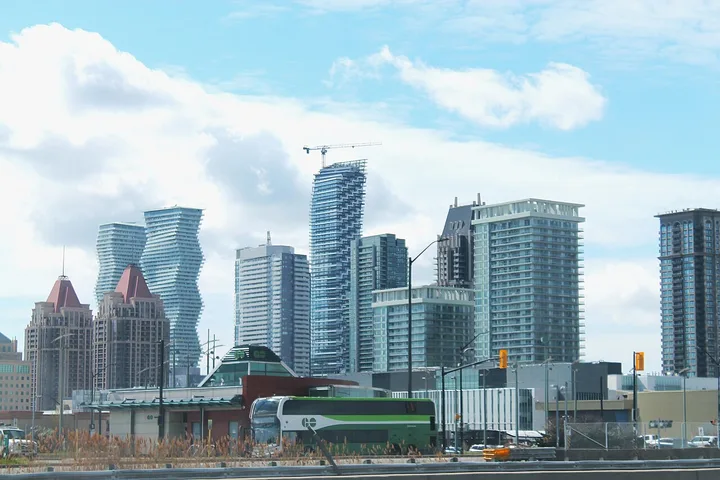
Mississauga is a city of 717,961 people (2021 Census) on Lake Ontario, just west of Toronto, and part of the Region of Peel. It grew from a string of villages into a city in 1974 and is known for Toronto Pearson Airport, Square One and its curving Absolute World towers.
On this page
Where is Mississauga?
Mississauga sits on the north shore of Lake Ontario, directly west of Toronto. Brampton lies to the north, Oakville to the west, and Toronto (Etobicoke) to the east. The Credit River runs through the middle of the city to the lake at Port Credit.
The city covers 292.74 square kilometres of land. It is one of three municipalities in the Region of Peel, with Brampton and Caledon. Toronto Pearson International Airport is inside Mississauga's borders, in the northeast corner of the city.
Mississauga has a two-tier government. The City runs transit, fire, parks, recreation, libraries and roads. The Region of Peel runs water, waste, public health, paramedics and social housing. The province is moving some regional jobs to the City (see the section on regional changes below).
Sources: Statistics Canada: Census Profile, 2021 Census, Mississauga (City) · The Canadian Encyclopedia: Mississauga · City of Mississauga: Indigenous heritage and early history
What is the population of Mississauga?
- 2001638,334 people
- 2006697,889 people
- 2011735,775 people
- 2016744,011 people
- 2021747,057 people
- 2025764,597 people
The 2021 Census counted 717,961 people in Mississauga, down 0.5 per cent from 721,599 in 2016. That makes it the seventh-largest city in Canada by census count. The median age was 40.8 and the average household had 2.9 people.
Statistics Canada's estimate for July 1, 2025 is 764,597. Estimates are adjusted for people the census missed, so they run higher than census counts and should not be compared with them directly. The City plans for 995,000 residents and 589,990 jobs by 2051, with a housing target of 120,000 new homes.
Sources: Statistics Canada: Census Profile, 2021 Census, Mississauga (City) · Statistics Canada: Population estimates, July 1, by census subdivision (Table 17-10-0155-01) · City of Mississauga: Growth forecasts and housing target
Who lives in Mississauga? Languages and backgrounds
| Measure | Mississauga, 2021 |
|---|---|
| Immigrants | 379,425 people (53.2 per cent of people in private households) |
| Visible minority population | 441,480 (61.9 per cent); largest groups South Asian, Chinese, Black, Arab and Filipino |
| Most common mother tongue | English (320,640 people) |
| Most common other mother tongues | Urdu (35,995), Arabic (33,265), Mandarin (23,180), Polish (22,070), Punjabi (20,690) |
| Can speak English and French | 47,965 people |
| Can speak neither English nor French | 24,550 people |
| Indigenous identity | 3,555 people |
| Homes owned | 70.4 per cent of households |
English is the main working language. The City's 311 line offers phone help in more than 240 languages and dialects.
Sources: Statistics Canada: Census Profile, 2021 Census, Mississauga (City) · City of Mississauga: How to use 311
Main areas and neighbourhoods
Mississauga is divided into 11 wards, each with one councillor. Many neighbourhood names come from 19th-century villages and post offices, such as Streetsville (1829), Erindale (1831), Cooksville (1839), Port Credit (1842), Malton (1856), Meadowvale (1857), Dixie (1864), Clarkson (1875), Lorne Park (1892) and Lakeview (1922).
- City Centre: the downtown around Square One, Celebration Square, the Civic Centre (City Hall) and the tallest condo towers.
- Port Credit and Lakeview: lakefront neighbourhoods at the mouth of the Credit River, with a harbour, marina, parks and a main street.
- Streetsville: a former village that became its own municipality in 1858, with a historic main street.
- Clarkson and Lorne Park: older, leafy lakeshore areas in the southwest.
- Cooksville and Erindale: central areas along Dundas Street and the Credit River valley.
- Meadowvale, Erin Mills and Churchill Meadows: large planned suburbs in the west and northwest, built mostly after 1970.
- Malton: the northeast neighbourhood next to Toronto Pearson Airport.
Sources: The Canadian Encyclopedia: Mississauga · City of Mississauga: City Council members
How do people get around Mississauga?
Most people drive. In the 2021 Census, 82.7 per cent of Mississauga commuters went to work by car, truck or van and 11.4 per cent used public transit.
MiWay is the City's bus service. It describes itself as Ontario's third-largest municipal transit system, with about 500 buses on 65 routes. The 18-kilometre Mississauga Transitway, a bus-only road with 12 stations from Winston Churchill Boulevard to Renforth Drive, opened in full in 2017 and is also used by GO and TTC buses.
GO Transit trains and buses link Mississauga with Toronto and nearby cities. The Hazel McCallion Line, an 18-kilometre light rail line with 19 stops from Port Credit GO to the Brampton Gateway Terminal, is still under construction. In August 2026, Metrolinx would not give an opening date.
Sources: Statistics Canada: Census Profile, 2021 Census, Mississauga (City) · City of Mississauga: About MiWay · City of Mississauga: Mississauga Transitway officially opens · insauga: Construction on Hazel McCallion LRT to continue into 2027 (August 12, 2026)
Economy and major employers
Mississauga has far more offices than most suburbs. In September 2026 the City said it is home to more than 115,000 companies, including more than 670 multinational head offices and more than 75 Fortune 500 firms. Key sectors include advanced manufacturing, technology, life sciences, logistics and financial services.
Large businesses in the city include Bell Canada, Canada Post, FedEx, General Mills, IMAX, Magellan Aerospace, Microsoft and Sobeys. Toronto Pearson, Canada's busiest airport, handled 47.3 million travellers in 2025, and nearly 50,000 people work on the airport grounds.
Sources: City of Mississauga: A decade of winning, Mississauga attracting business and investment (September 8, 2026) · The Canadian Encyclopedia: Mississauga · insauga: More than 47 million travellers passed through Toronto Pearson in 2025 (June 23, 2026)
What is the weather like in Mississauga?
| Measure | Value |
|---|---|
| January average temperature | -5.5 °C (average low -9.4 °C) |
| July average temperature | 21.5 °C (average high 27.1 °C) |
| Rain per year | 681.6 mm |
| Snow per year | 108.5 cm |
| Days above 30 °C | About 16 a year |
| Frost-free season | About 168 days |
Mississauga has cold, snowy winters and warm summers. The figures below come from the weather station at Toronto Pearson Airport, inside the city.
Hospitals, colleges and universities
- Trillium Health Partners runs the Credit Valley Hospital and the Mississauga Hospital, plus the Queensway Health Centre in west Toronto. The Mississauga Hospital site is being rebuilt as The Peter Gilgan Mississauga Hospital and the Shah Family Hospital for Women and Children, which Trillium says will together be the largest hospital in Canada.
- University of Toronto Mississauga opened in September 1967 as Erindale College with 155 students. It is now the University of Toronto's second-largest division.
- Sheridan College's Hazel McCallion Campus in the City Centre has about 4,400 full-time students and houses the Pilon School of Business.
- Health811, finding a family doctor and emergency care in Mississauga
- How to register a child for school in Mississauga
Sources: Trillium Health Partners: Overview · University of Toronto Mississauga: History of the campus · Sheridan College: Hazel McCallion Campus
Landmarks and what Mississauga is known for
- Square One: opened October 3, 1973, it was then the largest mall in Canada. Visit Mississauga says it is now the largest mall in Ontario.
- Absolute World towers: the curving condo pair nicknamed the Marilyn Monroe buildings, named the best new skyscraper of 2012 by Emporis.
- Celebration Square and the Civic Centre: the public square beside City Hall at the heart of the City Centre.
- Port Credit: the lakefront village at the mouth of the Credit River, near where the 1805 treaty was signed.
- Benares Historic House in Clarkson: a City museum believed to have inspired Mazo de la Roche's Jalna novels.
- Kariya Park: a Japanese-style garden opened in 1992 to honour sister city Kariya, Japan.
- Hazel McCallion: the mayor from 1978 to 2014, still the name most people link with the city.
Sources: Visit Mississauga: Square One · Construction Canada: Absolute World Towers earns international skyscraper honour (October 2, 2013) · City of Mississauga Museums: Mazo de la Roche · City of Mississauga: Sister cities · The Canadian Encyclopedia: Hazel McCallion
Mississauga and the Region of Peel: what is changing
In 2023 the province planned to dissolve the Region of Peel and make Mississauga a single-tier city by 2025. In December 2023 it changed course: Peel stays, and some services move to the cities instead.
Since July 1, 2024, the City, not the Region, is responsible for land use planning in Mississauga. The Peel Transition Implementation Act, 2025 received Royal Assent on December 11, 2025. It moves regional roads and their stormwater systems, and garbage, organics and yard waste collection, from the Region to Mississauga, Brampton and Caledon.
The City says regional roads move to Mississauga on July 1, 2027 and waste collection on October 1, 2027. Until then, the Region of Peel still collects waste. Blue box recycling has been run by Circular Materials for producers since January 1, 2026. Water, public health, paramedics and housing stay with the Region.
Sources: Region of Peel: Provincial review update · Environmental Registry of Ontario: Peel Transition Implementation Act, 2025, decision (ERO 025-0570) · City of Mississauga: Waste collection services will shift to Mississauga in 2027 (September 12, 2025) · City of Mississauga: 2026 Mayor's property tax newsletter (PDF)
Questions and answers
What is the population of Mississauga?
The 2021 Census counted 717,961 people. Statistics Canada's estimate for July 1, 2025 is 764,597, which includes an adjustment for people the census missed.
Source: Statistics Canada: Census Profile, 2021 Census, Mississauga (City)
Is Mississauga part of Toronto?
No. Mississauga is a separate city west of Toronto. It is part of the Region of Peel with Brampton and Caledon.
What is Mississauga known for?
Toronto Pearson Airport, Square One, the Absolute World towers, a large number of corporate head offices, and Hazel McCallion, its mayor for 36 years.
Is Toronto Pearson Airport in Mississauga?
Yes. The airport began as Malton Airport in the old Toronto Township, which is now Mississauga.
How many wards does Mississauga have?
Eleven. Each ward elects one councillor, and the city also elects a mayor.
What languages are spoken in Mississauga?
English is the most common mother tongue. The most common other mother tongues in 2021 were Urdu, Arabic, Mandarin, Polish and Punjabi.
Source: Statistics Canada: Census Profile, 2021 Census, Mississauga (City)
How cold does Mississauga get in winter?
January averages -5.5 °C at Pearson Airport, with average lows of -9.4 °C, and about 108 cm of snow falls in a year.
What bus system does Mississauga use?
MiWay, the City's transit service, with about 500 buses on 65 routes. GO Transit trains and buses also serve the city.
Source: City of Mississauga: About MiWay
When will the Hazel McCallion LRT open?
No date is set. In August 2026 Metrolinx said construction would continue for about another year, followed by testing, and declined to give an opening date.
Source: insauga: Construction on Hazel McCallion LRT to continue into 2027 (August 12, 2026)
What universities are in Mississauga?
University of Toronto Mississauga, which opened in 1967, and Sheridan College's Hazel McCallion Campus.
Source: University of Toronto Mississauga: History of the campus